Jump to How it works The Newsteer test Why now What people ask The pilot Pricing FAQ Request a demo →
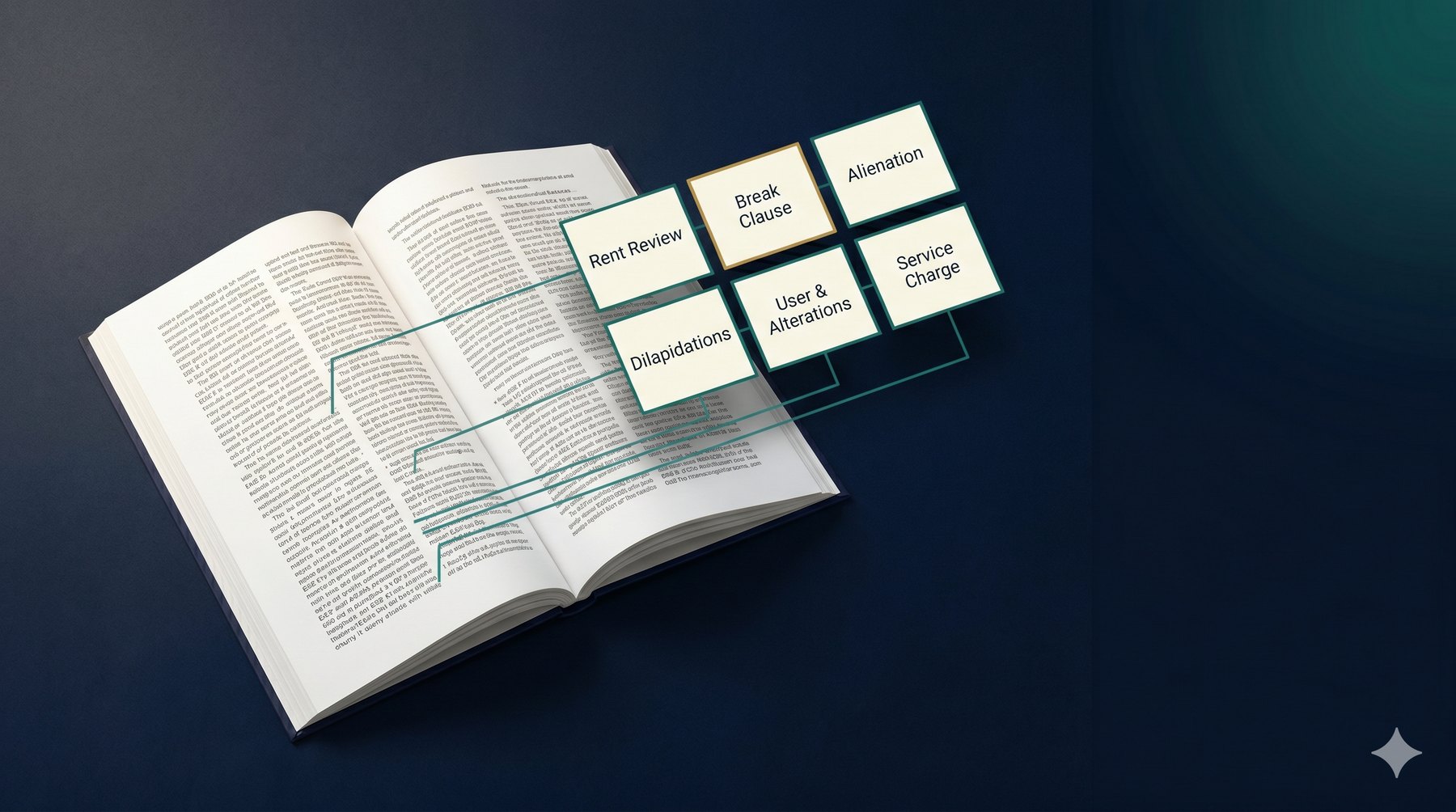
A commercial lease open on a desk, being read by LEASE-iQ Commercial. Six clause categories float as labelled cards above the lease, with Break Clause highlighted, suggesting the clause currently being read.
In pilot with Newsteer Real Estate Advisers

Every commercial lease hides a six-figure clause. Find it in under a minute.

Upload the lease. Ask any question, simple or complex. Get a clause-cited answer in under a minute, cross-checked by the Juror (10 parallel responses, outlier removal, 3-agent consensus vote). For any critical clause, click straight through to verify against the original PDF. That is the entire workflow.

For asset managers, corporate occupiers, real estate teams, in-house counsel, and the surveyors and lawyers that advise them.

Newsteer Real Estate Advisers First pilot user

Genuinely impressed. It cleanly parsed a 1963 Scottish commercial lease that would have taken a senior surveyor an hour to read carefully.

Grant Woollard, Director · Newsteer Real Estate Advisers · April 2026

30-day pilot Free. No card. No commitment.

This is what Grant was looking at when he said "genuinely impressed."

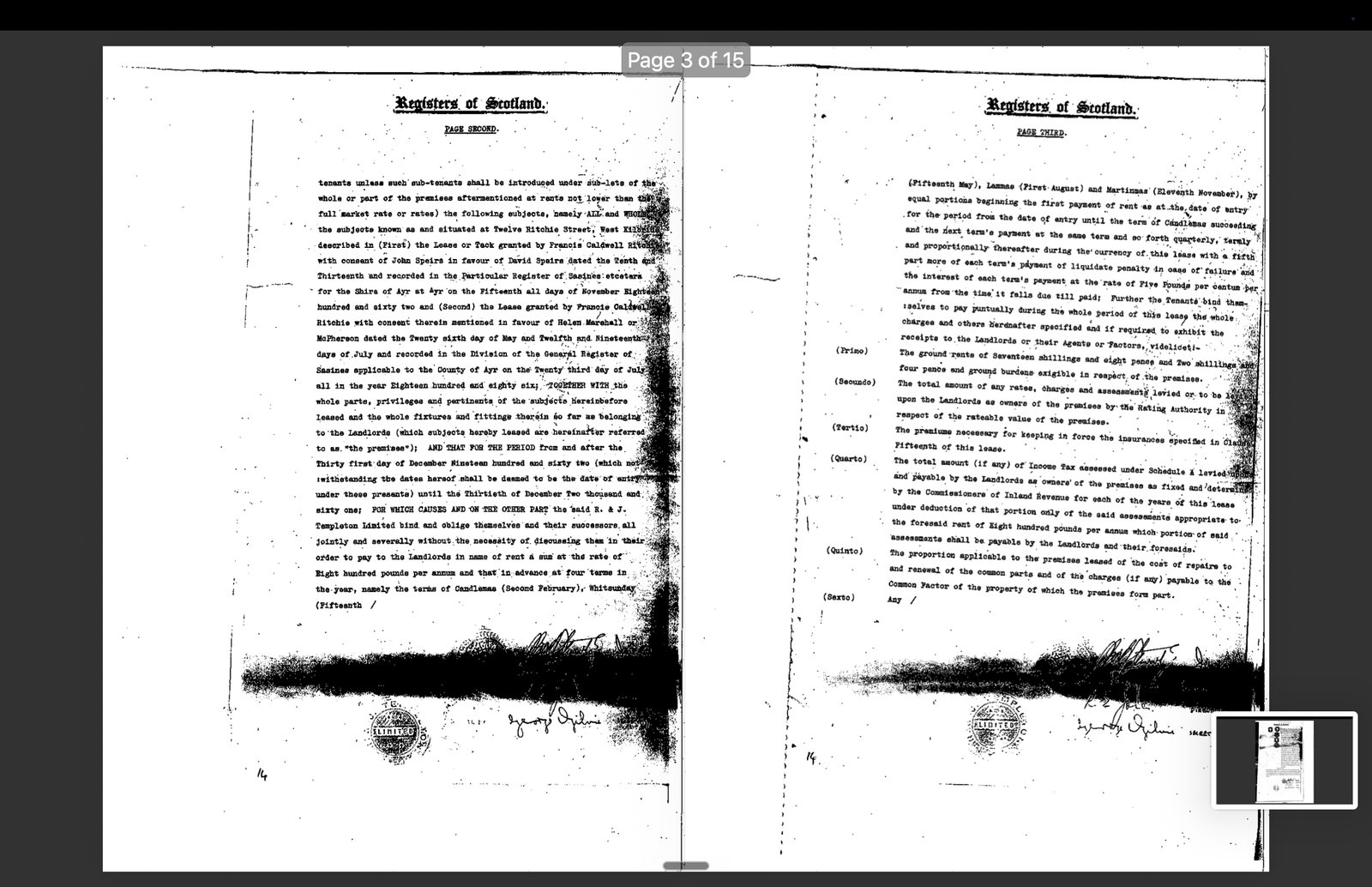
A 60-year-old commercial lease in Scots law, scanned from the Registers of Scotland. Heavy black smudging, Latin clause numbering (Primo, Secundo, Tertio), hand-stamps, fading ink. This is probably the hardest commercial lease we've ever processed. A senior surveyor reading it carefully would spend hours on it (Grant generously said "an hour" in the quote above), assuming they were willing to start. Below: the actual input and output from the Newsteer pilot.

Input What was uploaded
A photocopy of the 1963 Scottish commercial lease at Twelve Ritchie Street, West Kilbride, scanned from the Registers of Scotland. Two pages of typewritten text with heavy black smudging, Latin clause numbering (Primo, Secundo, Tertio), hand-stamps and signatures.

1963 commercial lease, Twelve Ritchie Street, West Kilbride. Scanned from the Registers of Scotland. Templeton Ltd. as tenant, registered 15 April 1963.

Output What LEASE-iQ returned
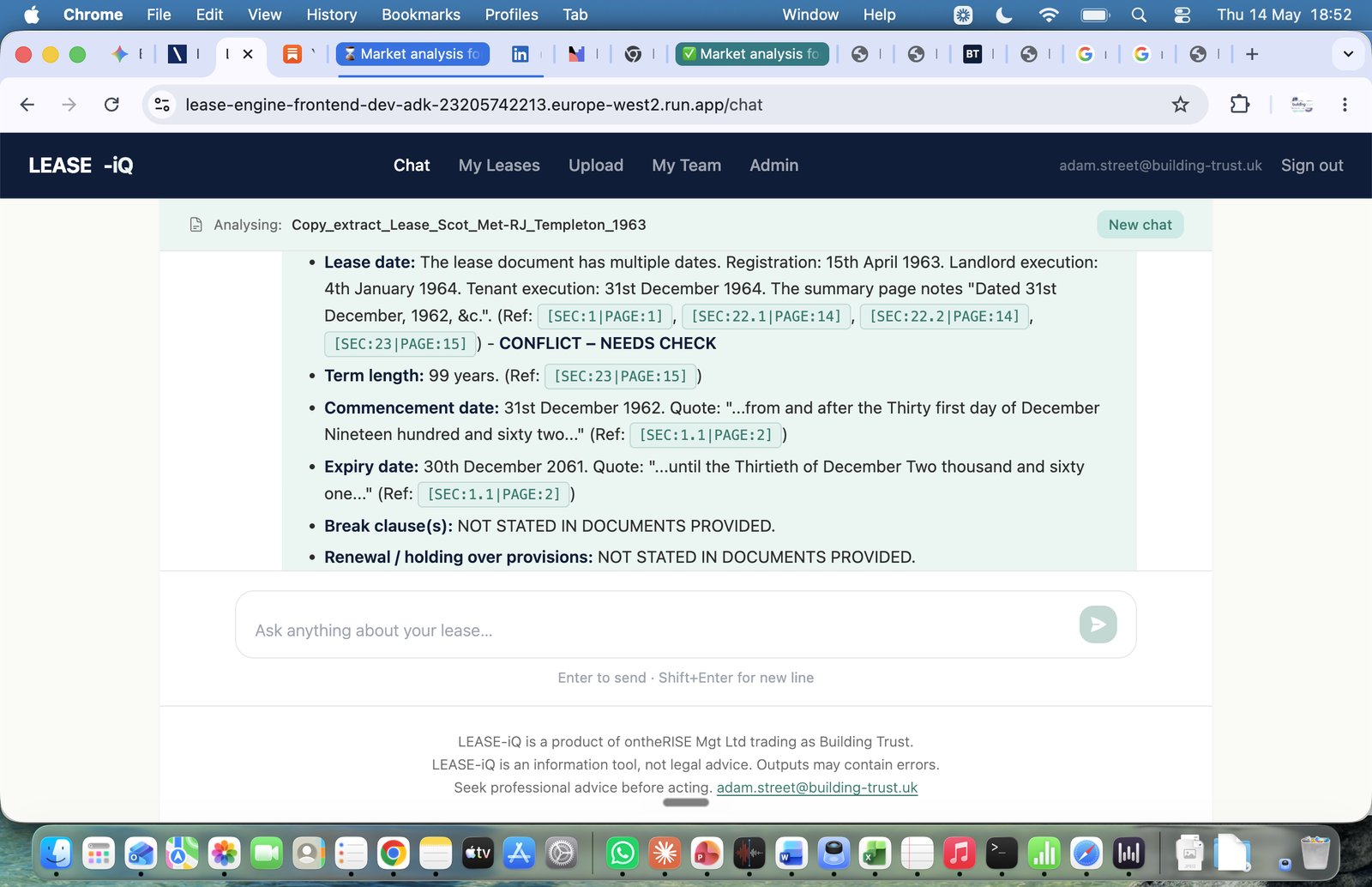
A screenshot of the LEASE-iQ Commercial chat interface, returning a clause-cited extraction of the 1963 Scottish lease. The output shows the property address with a [SEC:1.1|PAGE:2] citation tag, title number, and plan reference, with bullet-point structure.

A clause-cited extraction, in your hands within seconds. Every line carries a citation tag (e.g. [SEC:1.1|PAGE:2]) that links back to the original page. Items not stated in the documents are explicitly named, never guessed at.

Same lease, sixty seconds apart
Flagging uncertainty is a feature, not a bug

When the Jurors can't agree, the tool says so. CONFLICT. HUMAN CHECK. JURORS COULD NOT AGREE.

This 1963 lease is one of the hardest commercial documents we have ever processed. Smudged photocopy, Latin clause numbering, mixed-date registration, dual-execution, summary-page corrections. In short: almost unreadable.

The Juror found four different dates across registration, the landlord's execution, the tenant's execution, and the summary page. Ten independent responses were generated in parallel and three agents voted on the best answer. They could not agree on which date governs the lease.

So the tool said so. It named every candidate verbatim, gave the page reference for each, and flagged the field for human verification. No confident wrong answer. No averaged-out best guess. Just the truth about what it could and could not determine.

Confidently wrong is the failure mode you actually fear. Flagged uncertainty is the second-best outcome after a correct answer, and the only one that never transfers PI risk to your firm.

Screenshot of LEASE-iQ Commercial's output for the 1963 Scottish lease showing a CONFLICT - NEEDS CHECK flag against the Lease date field, listing four candidate dates (Registration 15th April 1963, Landlord execution 4th January 1964, Tenant execution 31st December 1964, summary page Dated 31st December 1962) each with a clickable SEC and PAGE citation tag.
<60s
First clause-cited brief on a 60-page commercial lease.
10 + 3
The Juror: 10 parallel responses, outlier removal, 3-agent consensus vote. Uncertainty flagged, never hidden.
£600/hr
Typical Magic Circle real estate partner rate. Most lease questions don't need it.
£1
Being £1 short on rent at the break date can void the entire break.

See LEASE-iQ read a lease.

The video runs the LEASE-iQ workflow in under a minute and returns clause-cited, statute-anchored output that an asset manager can act on.

One transparency note. The lease in the video is a residential lease, not a commercial one. Residential leases are publicly available from the Land Registry for around £7, so there is no confidentiality issue showing one in a marketing video. Commercial leases typically are not public, so we do not put a real one on a public website. The principles, the workflow, the clause-cited output, the human-in-the-loop verification step are all identical between residential and commercial. The question set differs (rent reviews, break clauses, alienation, dilapidations on the commercial side; service charge, extension premium, RTM on the residential side), the regulatory layer activated by lease type differs, the engine is the same.

Demo runs 90 seconds. No audio narration required.

The expensive problems in a commercial portfolio are quiet ones.

Rent reviews trigger silently. Break notices fail on a missed condition nobody read. Alienation consents stall on a definition buried in a schedule. Dilapidations exit costs run six figures because the schedule of condition wasn't anchored at lease commencement. The asymmetry: every one of these turns on a clause buried on page 47 of a 60-page lease, and the cost of missing it is paid in cash, not legal fees.

Problem 01

Rent review dates are missed.

Most leases require a trigger notice. Get the notice wrong, or miss the window, and the rent stays where it was for the next five years. Asset managers running mid-sized portfolios lose review uplift quietly because nobody is watching every lease.

Problem 02

Break notices fail on technicalities.

Time-of-the-essence service, vacant possession, condition compliance, no arrears, payment of supplemental rent. Every commercial litigator can name three failed breaks they were instructed to defend. The break clause was always exercisable. The execution wasn't.

Problem 03

Dilapidations exit is constructed, not calculated.

FRI leases shift the risk onto the tenant. The schedule of dilapidations at exit is a negotiated document, not an objective one. Without an anchored schedule of condition, photographic evidence, and a clean read of the user, alterations and reinstatement clauses, the tenant pays for what the landlord chooses to claim.

Problem 04

Alienation requests stall in consent procedure.

Assignment, underletting, and group-share clauses each have separate procedures and conditions. A delayed consent decision can void a sale or relocation deal. Most occupier teams don't know which conditions are actually contractual versus statutory, and which conditions on consent are likely to be unreasonable.

Problem 05

The lease against statute is the only honest answer.

The Landlord and Tenant Act 1954 Part II security-of-tenure framework and the Arbitration Act 1996 are both in the LEASE-iQ Commercial regulatory layer right now. The Handbook of Rent Review and the Handbook of Business Tenancies are on the roadmap, built from underlying case law and statute since the handbooks themselves are copyrighted. The lease alone does not tell you the answer. The lease against statute does. AI without that context gives a confidently wrong answer.

You don't pick a workflow. You ask a question.

LEASE-iQ Commercial works the way you'd actually use it. Upload your lease, ask anything in plain English. No template selection, no setup ritual. Below are the six question types that come up most in commercial portfolios. Real questions, not vendor categories. Pick one to see what comes back.

Rent review

Trigger date, basis, and fallback in one read.

LEASE-iQ Commercial extracts the review trigger date, the review basis (open market, RPI, indexed, fixed uplift), the timing requirements for the landlord's notice, and the tenant's counter-notice rights. It flags whether time is of the essence.

  • Calendar of every review date across the portfolio
  • Basis: market, indexed, hybrid, capped or collared
  • Notice format and counter-notice window
  • Time-of-the-essence flagging where the clause makes it material
Break clause

Conditions, deadlines, and what kills a break notice.

Reads break dates, notice windows, and conditions precedent (vacant possession, no arrears, condition compliance). Generates a break notice checklist tied to the actual lease wording and flags the conditions practitioners most often miss.

  • Hard deadline for service of notice
  • Conditions precedent extracted clause by clause
  • Rolling vs contractual break analysis
  • Draft notice in landlord-acceptable form
Alienation

Assignment, underletting, group share. The actual procedure.

Distinguishes the three alienation pathways and the conditions on each. Identifies whether AGA is required, whether surety is needed, what the consent procedure looks like, and which conditions on consent are likely to be unreasonable. Outputs a draft consent application or a draft refusal, depending on which side you're on.

  • Assignment, underletting, group share, charge
  • AGA / surety / financial covenant tests
  • Reasonableness of conditions on consent
  • Draft application or refusal letter
Dilapidations

Exit exposure, anchored to schedule of condition.

Reads the repair, decoration, alterations, and reinstatement covenants together. Cross-references against any schedule of condition limitation, supersession arguments, and the Dilapidations Protocol. Returns an estimated exposure range with the factual gaps you need to close before the schedule arrives.

  • Joint reading of repair, decoration, alterations and reinstatement
  • Schedule of condition limitations applied
  • Supersession analysis
  • Dilapidations Protocol compliance check
User & alterations

Permitted use, change of use, and the consent test.

Reads the user clause, the alterations regime (absolute, qualified, fully qualified), and any planning overlay. Identifies whether a proposed change of use or fit-out triggers consent, and what conditions a landlord can lawfully impose. Outputs a consent letter or a defence to a refusal.

  • User clause analysis with case-law references
  • Alterations regime (absolute / qualified / fully qualified)
  • Licence to alter checklist
  • Reinstatement obligation flagging
Service charge

Recoverable, capped, and what the lease actually allows.

Identifies what is in the service charge basket, what is excluded, and any caps or carve-outs. Flags clauses where the actual recoverability is narrower than the landlord may claim, and produces a defensible challenge or response position from the lease wording itself.

  • Recoverable / non-recoverable item map
  • Caps, carve-outs, and the proviso clauses
  • Sinking fund vs reserve fund distinction
  • Defensible challenge or response position

The trigger events. Don't read your portfolio. Search it.

A commercial portfolio runs on triggers, not documents. Here are the moments when LEASE-iQ Commercial pays back the investment in a single answer.

Trigger
The question
What you get back
Rent review approaches

What is the trigger date, what is the basis, what notice do I need to serve, and is time of the essence?

Calendar entry, draft trigger notice, fallback position if the date passes, time-of-the-essence flag.

Break clause window opens

Can I break? On what date, with what notice, subject to what conditions, and what kills the notice?

Hard deadline, conditions checklist, draft notice in landlord-acceptable form, the conditions practitioners most often miss flagged for you.

Tenant requests assignment

Can they assign? On what conditions? Is AGA required? Which conditions on consent are likely to be reasonable, and which are not?

Procedural map, financial covenant test, draft consent or refusal letter with reasons that survive challenge.

Lease expiry approaches

What is the dilapidations exposure, what does the schedule of condition cover, what reinstatement is required, what is the supersession position?

Estimated exposure range, missing factual gaps, defensible negotiating position, draft response to landlord schedule.

Service charge demand received

Is the cost recoverable under the lease, is it RICS-compliant, are caps applied correctly, are exclusions respected?

Line-by-line audit, recoverability map, draft challenge letter, RICS Code reference points.

Acquisition due diligence

What are the lease-level risks across the target's tenants? Which leases have onerous clauses, near-term breaks, or live disputes?

Portfolio-wide abstract, risk-ranked tenant list, calendar of all review and break dates, flagged onerous clauses.

Newsteer is the first pilot user.

Newsteer Real Estate Advisers is the first UK commercial firm running LEASE-iQ Commercial on real work. The trial started 29 April 2026 and runs for 30 days. Their senior team uses the tool on the leases that actually arrive on their desks. No artificial test cases. No demo theatre.

The pilot offer, in one sentence.

30 days. Free. Five seats. Your team uses LEASE-iQ Commercial on real work. If you don't get value, we turn it off. That's the entire deal.

At day 30 we ask one question: would you keep it, or would you rather we turned it off? If you'd keep it, we have a commercial conversation anchored on the value you've identified on your own leases. If not, we turn it off and we both learn something. No card collected at any point. No commitment beyond a 30-minute review meeting.

"Genuinely impressed. It cleanly parsed a 1963 Scottish commercial lease that would have taken a senior surveyor an hour to read carefully." Grant Woollard. Director, Newsteer Real Estate Advisers. April 2026.

What you get in 30 days

  • Five seats, full access
  • No payment details collected
  • Real-time support from the founder
  • Pilot feedback feeds the roadmap, subject to human-in-the-loop legal validation
  • 30-minute keep-it-or-turn-it-off review at day 30
  • Founding-customer pricing only if you continue

Upload. Ask. Verify.

No training. No fine-tuning. No template ritual. LEASE-iQ reads YOUR lease, every time. Newsteer's senior team got value on day one without any setup work, which is exactly the point.

Step 01

Upload the lease

PDF, scan, or even photograph. The engine OCRs, segments, and parses structure across clauses, schedules, definitions, and any deeds of variation that form part of the lease itself.

Step 02

Ask anything, simple or complex

Plain English. "What's the rent review trigger date?" or "Walk me through every break notice condition." Multi-question runs supported. Behind the scenes: the Juror runs 10 parallel responses, removes outliers, takes a 3-agent consensus vote, and flags uncertainty rather than guessing.

Step 03

Verify the critical clauses

Every answer cites the exact clause. For anything that matters, click straight through to the original PDF and read the clause yourself. The human verification step stays in your hands. PI risk doesn't transfer.

Why the QA stack matters.

Generic AI hallucinates clauses. It cites statutes that don't exist. It collapses hierarchical schedules into flat prose and loses the cross-references that change the answer. The cost of a confidently wrong answer in commercial real estate runs to six figures.

LEASE-iQ Commercial runs every output through a seven-layer cross-check. If the layers disagree, you see the disagreement, not a smoothed-over consensus. Ambiguity surfaced is risk reduced.

1
Clause extractor. Pulls the relevant clauses verbatim from the lease.
2
Statute mapper. Cross-references the clause against the applicable statutory framework.
3
Case-law layer. Identifies the leading authorities that interpret the clause type.
4
The Juror consensus model. Ten independent responses generated in parallel on the current frontier model. Three agents vote on the best answer.
5
Disagreement detector. Where the agents cannot agree, the disagreement surfaces as a flagged risk, not a smoothed-over consensus.
6
Hierarchy preservation. Clauses, schedules, definitions, and deeds of variation are read with the right precedence. Flat prose loses this.
7
Customer feedback loop. Pilot feedback feeds the regulatory layer. Updates land when the law moves, not on an automated cadence, subject to human-in-the-loop legal validation.

The expert verification step stays with you.

Reading a 60-page commercial lease line by line is tedious. Senior eyes glaze over by page 30 and miss the schedule-of-condition reference on page 47. LEASE-iQ Commercial does that extraction consistently across every page without fatigue, and surfaces the critical clauses for your review.

Every cited clause is one click from the original PDF. The surveyor, the in-house counsel, the partner sign-off, the expert reviews what matters most against source. That human-in-the-loop validation step is exactly where professional risk lives, and we deliberately keep it with you, not with the tool.

The same architecture sits behind the residential LEASE-iQ deployment at building-trust.uk, where getting a service charge or extension premium wrong is financially disastrous for the leaseholder. Whether that mechanism reduces your firm's professional risk in any given case is a judgment for the firm. We give you the verification step. You bring the expertise.

What LEASE-iQ Commercial isn't.

Worth naming the things sophisticated buyers always wonder, so we can move on.

  • A replacement for senior surveyor judgment. The tool extracts what the lease says. What to do with what it says is still your professional call, and your signature on the advice.
  • A replacement for solicitors on contested matters. For litigation, court proceedings, or contested Tribunal work that triggers Section 14 LSA 2007, you instruct an SRA-regulated solicitor. LEASE-iQ feeds them; it doesn't replace them.
  • A black box. Every answer cites the clause. Every clause is one click from the original PDF. If you can't verify it, we haven't built it right.

30-day pilot. Free. No card. No commitment.

After the pilot, we agree a per-lease or per-seat rate at the day-30 review, anchored on the time the tool actually saved your team. So you have a reference, here is what the standard alternatives cost.

Reference 01

Magic Circle real estate partner

£600 / hour

One to two hours per commercial lease read. £600 to £1,200 per lease before any drafting work begins.

Reference 02

Specialist legal abstracting

£150–£300 / lease

Manual abstract from a commercial real estate paralegal. Two to three day turnaround. Quality varies by provider.

LEASE-iQ Commercial

Free pilot, then quoted

£0 for 30 days

30 days free, no card. After the pilot, per-lease or per-seat pricing, agreed at the day-30 review based on what the tool actually saved you. Rate is fixed for 24 months for the first ten firms.

All prices exclude VAT. Pricing structure for firms 11+ will be published once the first ten paying customers are on board.

Get hands on, not watched at.

Most demos are sales theatre. Ours isn't. We send you a login within one working day. You upload one of your own commercial leases, ask the question you've actually been wrestling with, see the answer in your hands within minutes. If LEASE-iQ Commercial earns a place in your workflow, we talk pilot. If it doesn't, you've lost twenty minutes.

  • Your login, your lease, your real question
  • Clause-cited answer back in minutes, in your environment
  • Original PDF one click from every cited clause, for verification
  • Confidentiality maintained. Your lease is never used to train any AI model
  • No commitment to proceed afterwards. If it doesn't help, you walk.

Two fields. We take it from there.

Login arrives within one working day. Or book a 30-minute working session and we get the work done on the call.

Or, skip the form. Book a 30-minute working session →
We get you logged in, you upload one of your own commercial leases, ask the questions you have actually been wrestling with, and walk away with clause-cited answers. We do the work on the call.

Processed on GCP Europe West 2 (London). Contractually prohibited and architecturally isolated from model training, covering Google's models, our own, and any third party. Your information is used only to schedule and run the demo, never shared with third parties.

The questions buyers ask in the first call.

How is this different from the residential lease tool at building-trust.uk?
Same underlying engine. What differs is the audience, the typical questions, the regulatory layer the engine activates, and the price point. Building Trust at building-trust.uk serves residential leaseholders, RTM/RMC directors, and informal freeholders, working on residential lease problems (extension premiums, service charge challenges, FTT cases) at consumer pricing (around £50 a case). LEASE-iQ Commercial serves the professional buyer (surveyors, in-house counsel, asset managers, real estate partners) working on commercial leases with a different question set: rent reviews, break clauses, alienation, dilapidations, service charge, user and alterations. The engine reads both. For commercial leases the regulatory layer currently activates Landlord and Tenant Act 1954 Part II and the Arbitration Act 1996. The Handbook of Rent Review and the Handbook of Business Tenancies are on the roadmap, being built from underlying case law and statute since the handbooks themselves are copyrighted. For residential leases the engine activates LTA 1985/1987, BSA 2022, LFRA 2024, and the FTT (Property Chamber) jurisdiction. Lease type drives which layer applies. The site you're on is the commercial-buyer landing page.
Where is the data hosted and who has access?
All processing happens on GCP Europe West 2 (London). Your lease is contractually prohibited and architecturally isolated from model training, with the contractual position covering Google's models, our own, and any third party. Each pilot client gets a confidential environment.
What's the failure mode? Where does this tool get it wrong?
Generic AI fails on lease ambiguity. The Juror catches most of those cases by running 10 parallel responses, removing outliers via semantic similarity, taking a 3-agent consensus vote, and flagging uncertainty rather than guessing. The remaining failure mode is leases with structural ambiguity (e.g. competing definitions in different schedules) where any reader, AI or human, would need to flag the issue rather than answer it. We surface these as Risks rather than papering over them. For full context on why generic AI fails for leases and how we address it, see the architecture page on the residential site.
What does the pilot actually look like?
30 days, free, five seats. Your team uses the tool on real work. At day 30 we ask one question: do you want to keep it, or would you rather we turned it off? If you'd keep it, we have a commercial conversation anchored on the value you've measured. If not, we turn it off and both learn. No card needed during the trial. No commitment beyond a 30-minute review.
Is this a regulated legal service?
No. LEASE-iQ Commercial is a software tool that produces lease intelligence, not regulated legal advice. The output is designed to be reviewed by a qualified solicitor or surveyor before action where the matter requires it. For litigation, court proceedings, or anything requiring conduct of litigation under Section 14 LSA 2007, instruct an SRA-regulated solicitor.